Composting turns organic garden and kitchen waste into a valuable soil improver and natural fertiliser. But good compost is more than a pile of leaves, grass clippings and plant waste — decomposition needs the right conditions.
In our regional climate, maintaining the right balance of moisture, air, carbon and nitrogen is especially important. Get these conditions right, and microorganisms will do most of the work for you.
Where is the best place for a compost pile?
Choose a location that is easy to reach and does not interfere with everyday work in the garden.
The sunniest spot is not necessarily the best choice. Sun and wind make compost dry out faster, which means it will need more frequent watering. A partially shaded location protected from strong winds is usually more practical.
Compost can be made:
- in an open compost pile;
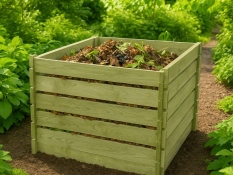
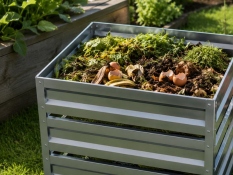
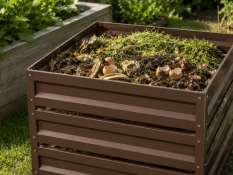
- in a wooden or other type of compost bin;
- in several adjacent bins for different stages of composting.
A multi-bin system is particularly convenient — fresh material goes into one section, compost matures in another, and finished compost can be taken from the third.
How should you prepare the base of a compost pile?
A compost pile should be set up so that excess water can drain away while preventing unnecessary loss of valuable nutrients.
If the soil is heavy and poorly drained, coarse structural material can be placed at the bottom. In a dry location, the priority is the opposite — preventing the compost from losing moisture too quickly.
Where additional drainage is needed, you can use a layer of wood chips or dry peat approximately 15–20 cm thick.
The basic rule is simple: compost should be moist, but it should not remain waterlogged.
How big should a compost pile be?
A compost pile that is too small struggles to retain heat. In a sufficiently large pile, microbial activity can raise the internal temperature considerably.
A useful guideline is a compost volume of at least around 1.5 m³.
During active composting, the temperature inside the pile can reach approximately 60 °C. This heat speeds up decomposition and can also reduce the viability of many weed seeds and some unwanted organisms.
Keep in mind that the volume of the compost will decrease considerably as the material decomposes.
What can you put in compost?
Good compost is made from a mixture of different materials rather than a single type of organic waste.
Suitable materials include fruit and vegetable scraps, grass clippings, autumn leaves, healthy plant waste, small twigs, weeds without mature problematic seeds, untreated wood, wood chips and other natural plant-based materials.
However, the balance between these materials is even more important than the exact list of ingredients.
Brown and green materials in compost
To understand how good compost works, remember two things: carbon and nitrogen.
Dry leaves, twigs, wood chips and similar dry materials are relatively rich in carbon. Fresh grass and other green plant material contain more nitrogen.
Microorganisms need both.
The ideal carbon-to-nitrogen or C/N ratio is approximately 25–30:1. Of course, there is no need to weigh everything with laboratory precision in a home garden. A much easier approach is to alternate dry “brown” materials with fresh “green” materials.
For example:
dry leaves → fresh grass → chopped twigs → plant waste → leaves.
This variety improves airflow and helps the materials decompose more evenly.
Why shouldn't fresh grass be added in a thick layer?
This is one of the most common composting mistakes.
Freshly cut grass contains plenty of nitrogen and moisture. When it is added in a thick, compact layer, there is not enough air inside the mass. Instead of composting efficiently, the grass may begin to rot and develop an unpleasant smell.
It is therefore better to mix fresh grass clippings with dry leaves, chopped twigs, wood chips or another carbon-rich material.
The same principle is useful in autumn. If you have plenty of fallen leaves but little nitrogen-rich material, mix the leaves with the last grass clippings of the season.
Should a compost pile be moist?
Yes. Microorganisms need water.
However, more water does not mean better compost. Excess moisture fills the air spaces between the materials and can create oxygen-poor, anaerobic conditions.
A useful rule of thumb is that compost should be moist, but not soaking wet.
If the material is dry and decomposition slows down, add a little water. If the compost is wet, compacted and begins to smell unpleasant, add dry structural material and improve airflow.
Do you need to turn the compost?
Composting requires oxygen, so turning the pile can significantly speed up decomposition.
However, there is no need to mix the compost constantly. Turning it too frequently can disturb established communities of microorganisms and fungal networks.
In practice, simply observe the pile. If it becomes too compact or wet, starts to smell unpleasant, or decomposition appears to have stopped, it is time to turn it.
Coarser twigs and other structural materials also help air penetrate deeper into the pile without frequent turning.
Should you cover a compost pile?
It is useful to protect compost from both excessive drying and prolonged heavy rain.
A cover helps maintain more consistent moisture levels and reduces nutrient leaching. However, the compost should not be sealed airtight because decomposition requires oxygen.
The aim is not to completely “wrap up” the compost but to protect it while maintaining good ventilation.
Can diseased plants and weeds be composted?
This requires some caution.
A hot, properly managed compost pile can reach temperatures at which some weed seeds and plant pathogens lose their viability. However, a home compost pile does not always reach the required temperature throughout its entire volume or maintain it for long enough.
For this reason, it is safer to keep severely diseased plants and problematic weeds with mature seeds out of the compost.
Remember: the quality of finished compost begins with what you choose to put into the pile.
Why does compost sometimes smell bad?
Healthy aerobic compost usually has a pleasant earthy smell similar to forest soil. A strong unpleasant odour is often a sign that something is out of balance.
Common causes include too much moisture, excessive amounts of fresh grass or other nitrogen-rich material, compacted contents and insufficient airflow.
The solution is often simple: turn the compost and mix in dry leaves, twigs, wood chips or another dry structural material.
How do you know when compost is ready?
In finished compost, most of the original materials are no longer recognisable. The compost becomes dark, loose and crumbly, with a texture similar to fertile soil.
It should have a pleasant earthy smell rather than smelling of fresh plants or rotting organic matter.
Finished compost can be used to improve garden soil, enrich vegetable and flower beds, spread around plants and support many other soil-improvement tasks.
The basic principle of composting is surprisingly simple: give microorganisms moisture, air, carbon and nitrogen — then let them do their work. A well-managed compost pile reduces garden waste while returning valuable organic matter to the soil.